
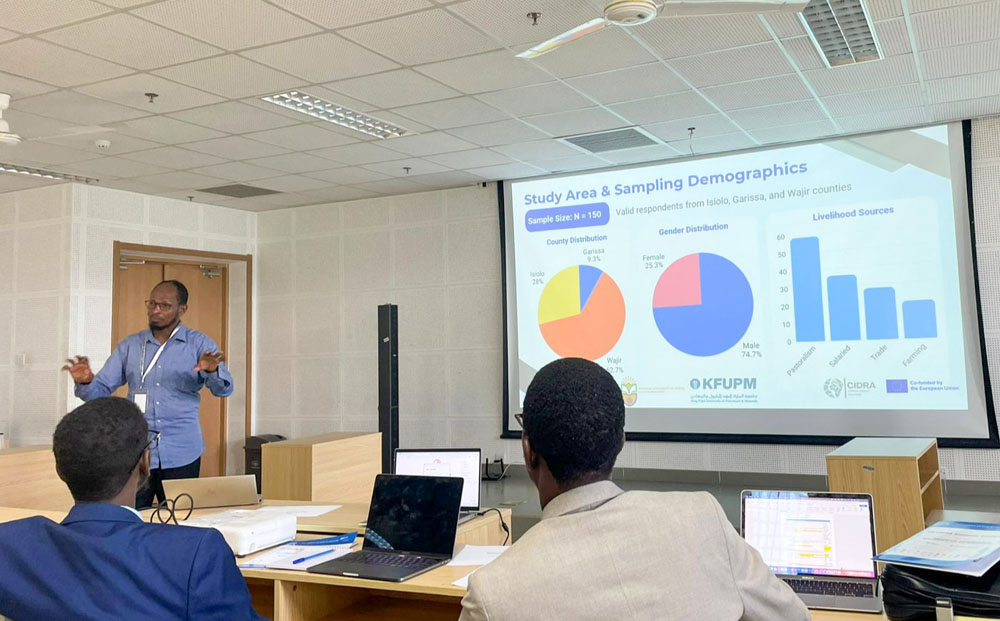
The study, titled: ‘The Regional Impact of Transport Infrastructure: A Case Study of the Samatar–Wajir Road in North Eastern Kenya’ was presented by Dr. Ali Adan Ali, from the Department of Physics, Earth, and Environmental Sciences, and Dr. Linnet Henry Hamasi, from the Department of Liberal Development and International Studies—both of the Technical University of Kenya—together with Prof. Fahad Albylwi of KFUPM. Prof. Albylwi and Dr. Hamasi served as the project’s Principal Investigators, while Dr. Ali acted as the Project Coordinator.
Upon completion of the 157‑kilometre Samatar–Wajir Road, currently under construction, the research evaluated projected socio‑economic and developmental outcomes of this important transport corridor. The project is funded by the Kingdom of Saudi Arabia to enhance connectivity in Kenya’s arid and semi‑arid North Eastern region.
Using the internationally recognized OECD‑DAC (Organisation for Economic Co-operation and Development - Development Assistance Committee) evaluation framework, the study assessed project relevance, effectiveness, efficiency, impact, and sustainability based on community‑level evidence collected from Isiolo, Garissa, and Wajir counties.
Findings presented at the conference indicate that the road would significantly improved access to markets, reduced travel times, strengthened links to health and education services, and contributed to enhanced household economic well‑being and security.
Dr. Ali noted that; the Samatar–Wajir Road is a transformative asset that would demonstrate high relevance and effectiveness. With strategic focus on maintenance financing, gender inclusion, and institutional capacity, its greatest impacts will be generational.
“The Road will not merely carry vehicles across 157 Kilometers of arid terrain. It will carry the aspirations of communities long overlooked by the arc of national development—and deliver them to a future of greater opportunity, dignity, and prosperity.” Dr. Ali said.
A strong majority of respondents rated the project as highly relevant to local needs. At the same time, the research highlighted important policy considerations, including challenges related to construction efficiency, long‑term maintenance financing, and institutional capacity for sustainability.
Beyond its local development implications, the study situates the Samatar–Wajir Road within a broader framework of Saudi–Africa development cooperation, illustrating how infrastructure investments can function as instruments of regional integration, diplomacy, and long‑term partnership when aligned with inclusive development strategies.
The presentation formed part of a multidisciplinary conference that brought together scholars and policymakers to examine regional and transregional dynamics shaping law, governance, development, and cooperation across Africa and beyond.
Participation in the CIDRA Academic Conference underscores the Technical University of Kenya’s commitment to applied, policy‑relevant research, international collaboration, and knowledge exchange addressing real‑world development challenges.
Acknowledgements, Funding, and Ethics
The research team acknowledges the communities of Isiolo, Garissa, and Wajir counties for their cooperation and participation in the study. Appreciation is also extended to the Kingdom of Saudi Arabia and its people for their support to the Government and citizens of Kenya through the Samatar–Wajir Road Project. The Project team also thanked the Administration and the Directorate of Research and Knowledge Management of The Technical University of Kenya for their support during the project implementation.
Funding: This research, titled “Evaluating the Impact of Saudi Arabia–Funded Infrastructure Development in Kenya: A Case Study of the Samatar–Wajir Road in the North Eastern Region,” was supported by the Deanship of Research at King Fahd University of Petroleum & Minerals (KFUPM) under the Research with Humanity Microgrant, project number RHM25101.
Ethical Approval: Ethical approval was granted by the Institutional Scientific Ethics Review Committee (ISERC) of the Technical University of Kenya and the National Commission for Science, Technology and Innovation (NACOSTI).