
Universities have been challenged to take their position as engines of innovation and must transform knowledge into value in order to play a central role in national and continental development.
The remarks were made by Key note speaker Prof. David Minja, during the fourth Day of the 5th TU-K International Conference. He emphasized that Africa must become a creator, not merely a consumer, of innovation.
Prof. Minja, Chairperson, Public Policy Professionals Society of Kenya was addressing a topic on, ‘Transformative Governance and Innovation Ecosystems for Sustainable Futures.’
He challenged Government and policymakers to provide enabling policy frameworks, appropriate legislation and infrastructure that support collaboration between different actors.
He noted that for too long, institutional success has largely been measured through graduates produced, academic programmes offered and research publications accumulated. These he noted remain important, but they cannot be the only measures of relevance.
Prof. Minja explained that Africa has the intellectual capacity, human resources and institutional infrastructure to address its development challenges and wondered why the continent dependent heavily on foreign ideas and innovations.
He asked if it was a question of how institutions and systems are organized, governed and translate knowledge into practical outcomes.
“Our greatest challenges is not necessarily the absence of knowledge, but our inability to connect knowledge with opportunity, research with industry, innovation with investment, and policy with implementation.”
He explained that many institutions continue to operate in isolation noting that it was time to move from institutional silos to systems thinking.
“The world is an interconnected system. Decisions made in one institution have consequences for others. Education influences productivity; research drives innovation; innovation transforms industry; and governance determines whether these relationships create sustainable development.”
He reiterated that universities conduct research that industries never utilise.” We have industries seeking solutions that universities have the capacity to develop. We have policies that are well articulated but poorly connected to implementation,” said he.
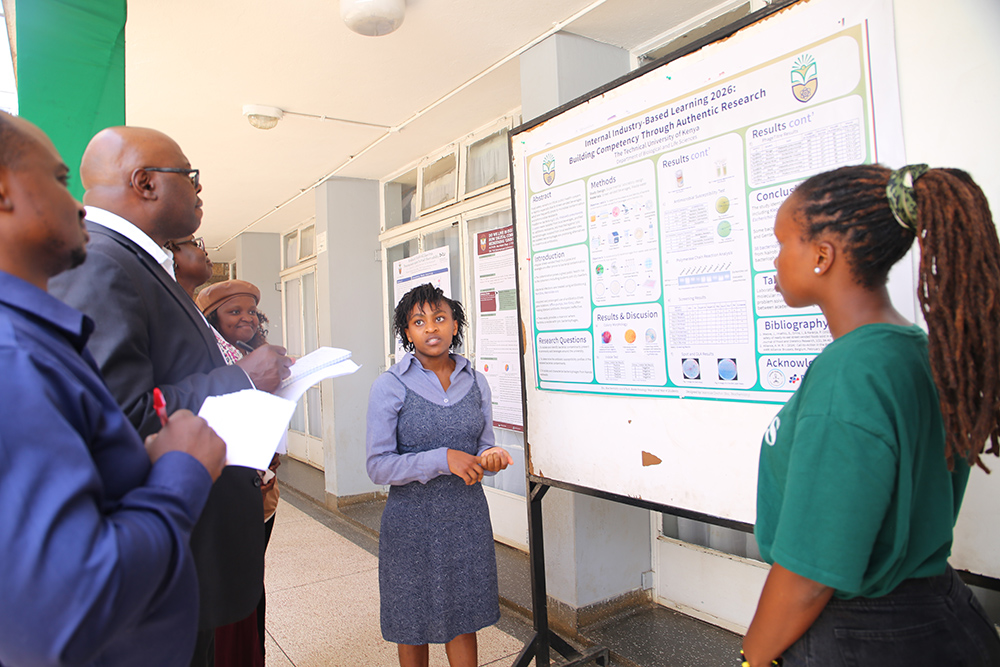
Delegates held plenary sessions at different venues.
The Faculty of Applied Sciences and Technology (FAST) had different topics key among them, Mathematical Modelling of The Impact of Family-Based Helicobacter Pylori Infection Prevention and Control Measures on Stomach Cancer Dynamics, Innovating Safety and Security from Laboratory best Practices to Cross-Border Threat Reduction among others.
Faculty of Social Sciences and Technology (FSST) held a topic on, Commercialisation of Innovation while Faculty of Engineering and the Built Environment (FEBE) held a session on, Smart Infrastructure, Sustainable Cities, and the Built Environment.
Dignitaries drawn from other countries are gracing the conference among them;
Dr. Rainstorm Euphrase- Advisor to the Burkina Faso Minister for Health
Prof. Shehu Usman Gulambe, DVC in charge of Academics at Usman Danfodiyo University in Sokoto, Nigeria, among others.
Prof. Gulambe asserted that there was a need to strengthen the relationship between academia and industry. Research should respond to real-world challenges, while industry should become an active partner in research, innovation and commercialisation.
“Our universities must develop the capacity to generate prototypes, protect intellectual property, establish innovation hubs and create pathways through which research attracts investment and generates sustainable revenue,” said Prof. Gulambe adding that this required a fundamental shift in mindset, institutional management and leadership.
“We must create environments where innovation is encouraged rather than constrained by unnecessary bureaucracy.”
The Deputy Vice-Chancellor in charge of Research and Technology Development (RTD) Prof. Isaac Orina noted that Africa has talented researchers, skilled professionals, entrepreneurial communities and universities capable of contributing to global knowledge. That the continent needs stronger systems for connecting these resources.
This, he added required investment in research, institutional partnerships, innovation, financing and an enabling commercial environment.