
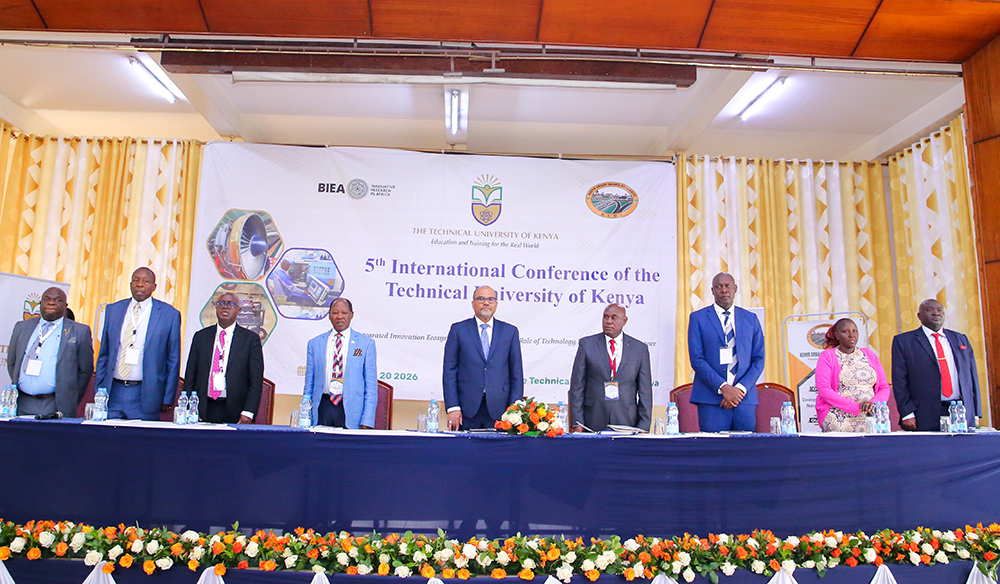
Universities must move beyond publishing papers and instead put their research to work to solve Kenya’s everyday challenges, State Department for Science, Research and Innovation Principal Secretary Prof. Shaukat Abdulrazak has said.
The PS said this when he presided at the openning of the 5th TU-K International Conference. The Conference is themed: “Building Integrated Innovation Ecosystems Beyond 2030: The Role of Technology, Training, and Governance. It capped TU-K’s inaugural Research Week 2026.”
The conference attracted delegates from government, industry and academia. Those who attended included Kenya Urban Roads Authority Director-General Eng. Silas Murira Kinoti, National Commission for Science, Technology and Innovation (NACOSTI) Chair Prof. Vasey Mwaja, and National Research Fund Chair, Dr. Thomas Serrem. The Chair of the Kenya National Innovation Agency (KeNIA) and a representative of the British Institute in Eastern Africa.
TU-K Vice-Chancellor, Prof. Benedict Mutua, flanked by Deputy Vice-Chancellor, Research and Technology Development, Prof. Isaac Orina, members of the University Management, scholars, researchers, innovators, students and students also attended.
Prof. Abdulrazak urged universities to embrace emerging technologies such as artificial intelligence, biotechnology, robotics and renewable energy to tackle problems facing society.
“We cannot afford to continue doing what we have been doing. We should think outside the box and where possible create new boxes.”
The PS asked researchers to ensure that at least 30 per cent of the papers presented speak to real societal needs. He pointed to post-harvest losses of almost 30 per cent, the burden of cancer and the need for more skilled engineers as problems research must help solve.
With more than 86 universities and over 25 research institutions in the country, he said, Kenya “cannot afford to have duplication of efforts.” He also called on universities to produce job creators rather than job seekers.
PS further stated that the government had launched the Science, Research and Innovation Synergy Blueprint and the Research Financing and Capacity Strengthening Master Plan to place research at the centre of national development. A Grand challenge to bring scientists together around societal problems will be launched soon, he added.
Eng. Silas Kinoti, said the future of any country is urban. “80 per cent of the GDP of any country comes from urban areas,” he said.
He noted that KURA was investing in research partnerships with universities. They include an AI-based road condition and maintenance project with Dedan Kimathi University of Technology, and smart traffic systems at major Nairobi junctions. Solutions, he said, must be tailored to each urban centre.
The VC, Prof. Mutua stated that TU-K believes “Africa must be a creator of technology and not just a consumer of it.” He said the conference rested on three connected pillars including technology, training and governance.
Deputy Vice-Chancellor, Research and Technology Development, Prof. Isaac Orina noted that the conference should mark the beginning of a sustained institutional commitment to research excellence, innovation, and collaboration.Conference Planning Committee Chair Prof. Florence Oloo said research must reach beyond the academic page. “Research must not remain confined to conference proceedings, academic journals, or institutional repositories.”
She pointed out that the true value of research lies in its ability to inform policy, improve livelihoods, create jobs and solve real-world problems. She urged delegates to leave the conference with stronger partnerships and a renewed commitment to making innovation work for society.
Discussions ran across three tracks that reflected TU-K’s multidisciplinary strength. Under Applied Sciences and Technology, presenters explored bio-innovation, data science and AI, nanotechnology, safety and security, digital agriculture, and Earth and environmental sciences.
The Engineering and the Built Environment track focused on smart infrastructure, advanced manufacturing and Industry 4.0, green engineering and renewable energy, and robotics and emerging engineering innovations. The Social Sciences and Technology track covered digital communication, open knowledge and cultural heritage, commercialisation of innovations, diplomacy and cybersecurity, digital rights, and capacity building for the new workplace.