
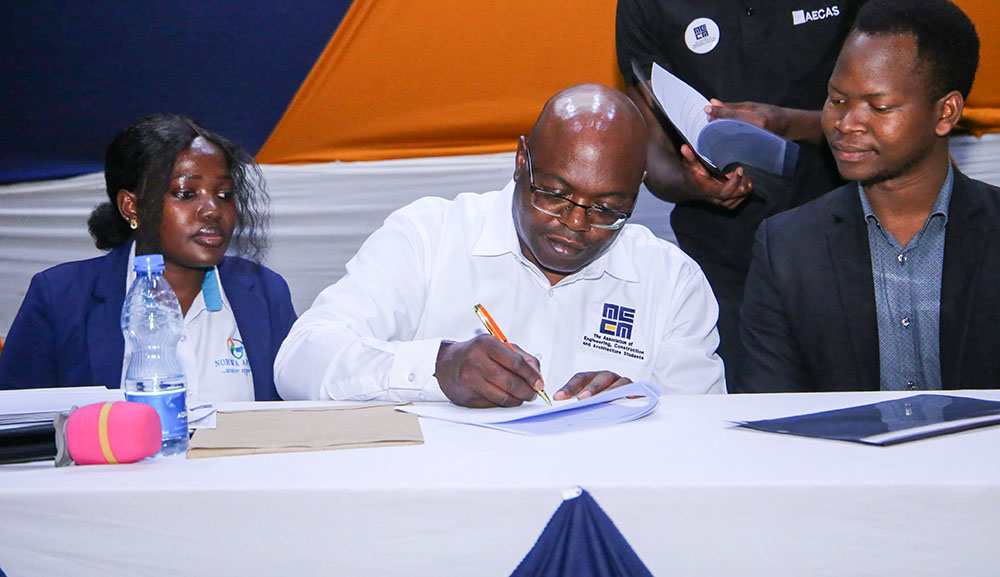
The Association of Engineering, Construction and Architecture Students (AECAS) Club on Thursday September 1, 2026 signed a Memorandum of Understanding (MoU) with Norwa Africa, a water engineering company that provides water treatment, water pumping and solar solutions to communities across Africa.
The MoU was signed during the Club’s Annual General Meeting (AGM) in the Lecture Theatre. Students would benefit from industrial attachment, internships, research, projects and professional development opportunities.
Speaking during the event, Norwa Africa Operations Manager, Swahib Asman, said the partnership would support students as they transition from university to the workplace.
“We are going to be with you along the journey. We are going to support you in terms of industrial attachment and also offer internships according to the MoU we are signing.”
He added that the partnership would also support students undertaking research and academic projects, particularly those pursuing electrical, mechanical and chemical engineering programmes.
Norwa Africa Special Programme Manager, Charity Bright, said the partnership would provide students with an opportunity to gain practical experience and develop skills that complement their classroom learning.
“After school, the first question we will come across is, ‘What experience do you have?’ So, where do we get this experience if no one opens the door for us to practise what we have learned in school?”
Deputy Vice-Chancellor, Institutional Advancement and Enterprise, Prof. Paul Wambua, delivered the opening remarks on behalf of Vice-Chancellor Prof. Benedict Mutua.
The Vice-Chancellor commended AECAS for promoting mentorship, peer learning and interdisciplinary collaboration, noting that the Club’s activities align with the University’s commitment to holistic and future-oriented education.
He urged the Club members to focus on three key areas: academic excellence and innovation, industry linkages and professional development, and community engagement and sustainability.
“Partnerships with industry are essential in bridging the gap between theory and practice.”
The VC further challenged the students to consider the wider social and environmental impact of their professions, noting that engineering, architecture and construction should respond to the needs of the communities they serve.
“Engineering, architecture and construction are not only about structures. They are about people, communities and environments,” he said.
He also observed that structures are designed for people and therefore professionals in the built environment must consider human needs and the environments in which their projects are developed.
“It is actually not possible to design a structure without involving human beings because this structure will not be somewhere in space. It will be where we are living, all of us.”
Prof. Mutua thus encouraged AECAS members to champion projects that address local challenges, including affordable housing, climate resilience and sustainable urban planning, noting that such initiatives demonstrate the University’s commitment to service and social responsibility.
Prof. Evans Vidija Sagwa, encouraged students to participate in the upcoming 5th TU-K Conference scheduled for 16–20 November 2026. He said the conference would provide opportunities for students to present their work, engage with industry and government representatives, and build professional networks.
A team led by Ms. Stacy Awinja from the Centre for Design Innovation and Engineering at Kenyatta University also made a comprehensive presentation on their work and avenues for partnership.
AECAS Club Patron, Dr. Joseph Kedogo, commended the Club’s growth and its interdisciplinary approach, noting that the association had brought together students from diverse disciplines within the built environment and beyond.
Club President El-Bethel Buyanzi said the Club would continue to prioritise collaboration, professional exposure and technical development by creating opportunities for students to engage professionals, visit industry environments and work across disciplines on practical projects.
The AGM brought together student leaders, academic staff and industry representatives to review the Club’s achievements, deliberate on its programmes and chart its priorities for the coming year.